Beyond the Glass Slab: The Wildest Smartphone Concepts We’ve Seen So Far
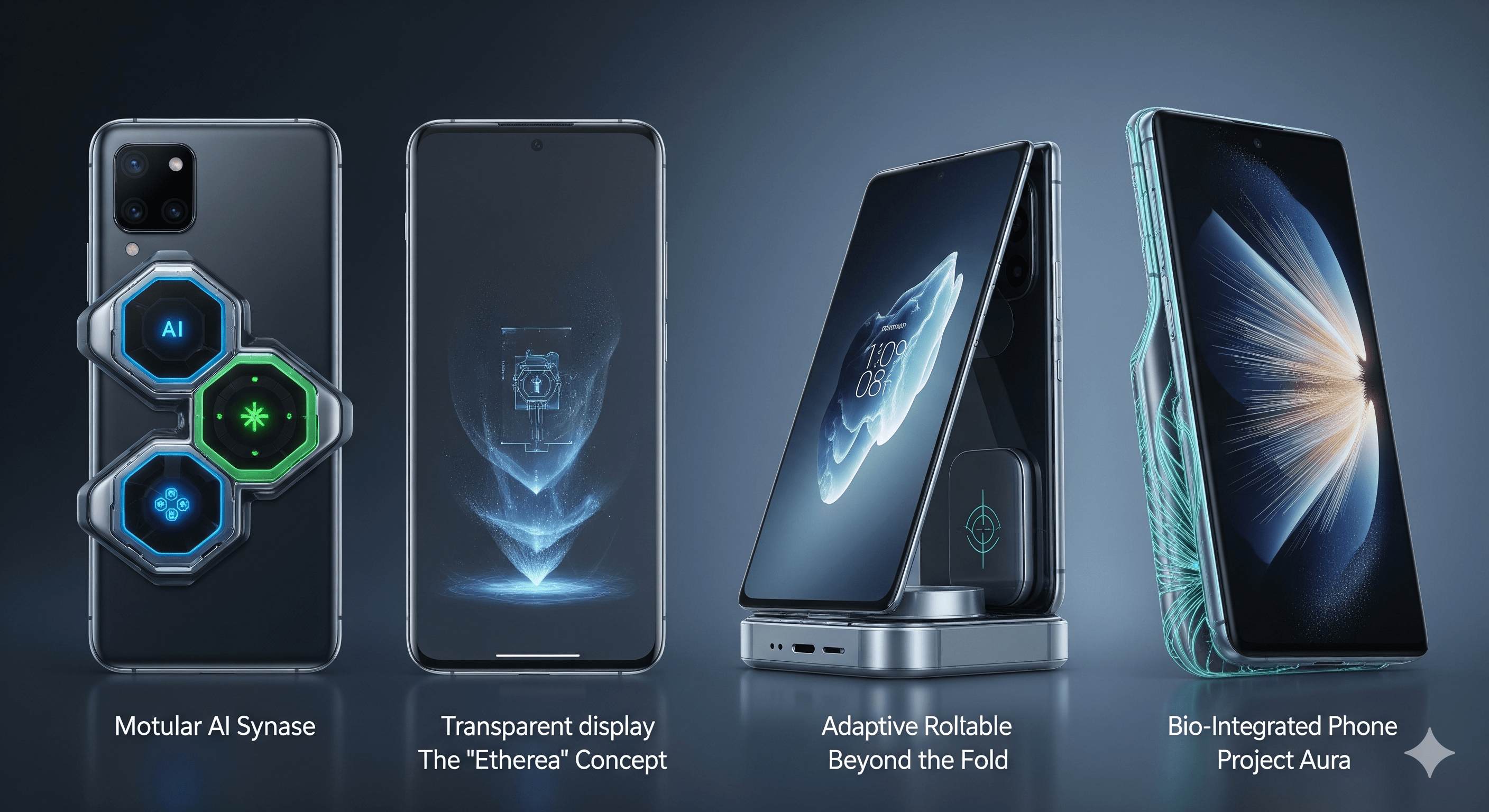
For nearly two decades, our digital lives have been dictated by the immutable glass and metal rectangle. The monolithic smartphone, a marvel of its time, has become a victim of its own success—a landscape of iterative updates in a sea of sameness. But here in 2025, the pressure is building, and the form factor is finally starting to crack. We’re venturing beyond the glass slab into a new era of experimental, hyper-personalized, and downright wild mobile concepts. These aren’t just fantasy renders; they are the tangible results of massive R&D investments, signaling where the future of personal computing is headed.
1. The Modular AI Phone: Project Synapse
The AI boom of the early 2020s has fundamentally changed software, and now it’s coming for hardware. The “one-size-fits-all” approach to on-device processing is proving inefficient. Enter the concept of the modular AI phone, best exemplified by internal documents leaked from a major tech giant’s skunkworks lab, codenamed “Project Synapse.”
How It Works:
The core device is a sleek chassis with a powerful base CPU and display. The magic lies in the back, which features a magnetic pogo-pin system for hot-swappable “Neural Modules.” These are specialized hardware accelerators, each tailored for a specific AI task:
- The “Cognito” Module: A low-power, high-efficiency chip for running advanced Large Language Models (LLMs) locally, enabling truly private, instantaneous AI assistants.
- The “Imago” Module: Packed with tensor cores dedicated to generative imaging and real-time video processing, allowing for on-the-fly style transfers and object creation that would currently require a cloud connection.
- The “Kinetix” Module: Focused on predictive analytics and sensor fusion, designed for athletes or industrial workers to get real-time biometric and environmental analysis.
This isn’t just about customization; it’s about future-proofing. As AI models evolve, you upgrade the module, not the entire phone. A recent TechCrunch analysis from February 2025 highlights this trend, stating that “the demand for specialized, on-device AI is creating a new market for bespoke hardware solutions that could fragment the processor market as we know it.”
2. The Transparent Display: The “Etherea” Concept
What if your phone could simply… disappear? Building on the transparent micro-LED television displays that stunned audiences at CES 2025, several boutique hardware startups are racing to miniaturize the technology. The most compelling of these is the “Etherea” concept.
“It’s a device that’s present only when you need it. The rest of the time, it’s just a window to your world.”
When inactive, the Etherea is a crystal-clear pane of Gorilla Glass Victus 3. But when it powers on, the display offers startlingly vibrant and opaque imagery. The concept’s killer feature is its dual-sided display capability, allowing it to overlay information on the world behind it—a true “magic window” for augmented reality without a headset. Of course, the challenges are immense: hiding circuitry and a battery remains the primary engineering hurdle. But progress is rapid. A January 2025 report from The Verge notes that breakthroughs in transparent battery technology could make a consumer-ready version viable by 2028.
3. The Adaptive Rollable: Beyond the Fold
Foldables are no longer a novelty. With the global market projected to ship over 55 million units in 2025 (per a Q1 2025 IDC forecast), manufacturers are looking for the next evolution. That evolution is the rollable.
We’ve seen prototypes for years, but the 2025 concepts from players like Motorola and Samsung Display are different. They aren’t just phones that unroll into tablets. They are truly *adaptive*. Imagine a phone that starts as a compact 5-inch device. A double-tap on the side causes it to smoothly expand to a 6.7-inch standard size. Need more screen real estate for a movie? It continues to unroll into a 16:9 8-inch mini-tablet. The internal mechanisms are now reportedly durable enough for over 300,000 actuations, and the tell-tale crease of early foldables is virtually nonexistent.
4. The Bio-Integrated Phone: Project Aura
The final frontier isn’t about the screen; it’s about the chassis itself. “Project Aura” is a conceptual device that blurs the line between technology and biology. Its case is made from a self-healing biopolymer infused with a network of graphene sensors.
This isn’t just a phone; it’s a wellness companion. It passively and continuously monitors:
- Galvanic Skin Response: To measure stress and emotional arousal.
- Hydration Levels: Through subtle conductivity changes in your palm.
- Heart Rate Variability: Far more accurately than a watch, via constant contact.
The phone’s interface adapts to this data. If it detects high stress levels, the UI might subtly shift to calmer hues, and the notification haptics could become softer and less intrusive. This aligns perfectly with the “Ambient Wellness” trend that Bloomberg Intelligence pinpointed as a key driver for 2025. While the privacy implications are enormous, the potential for a device that truly understands and responds to its user’s physiological state is a powerful, if slightly unnerving, vision of the future.
The Shape of Things to Come
Modular, transparent, rollable, and even biological—these concepts show that the smartphone’s final form is far from settled. While the simple glass slab will likely remain the workhorse for years to come, the edges of the market are becoming far more interesting. These experiments aren’t just flights of fancy; they are the proving grounds for the technologies that will define the next generation of personal computing. The rectangle had a great run, but its reign is no longer absolute.